
English Essay
- The Science of the 2500 Words Argument
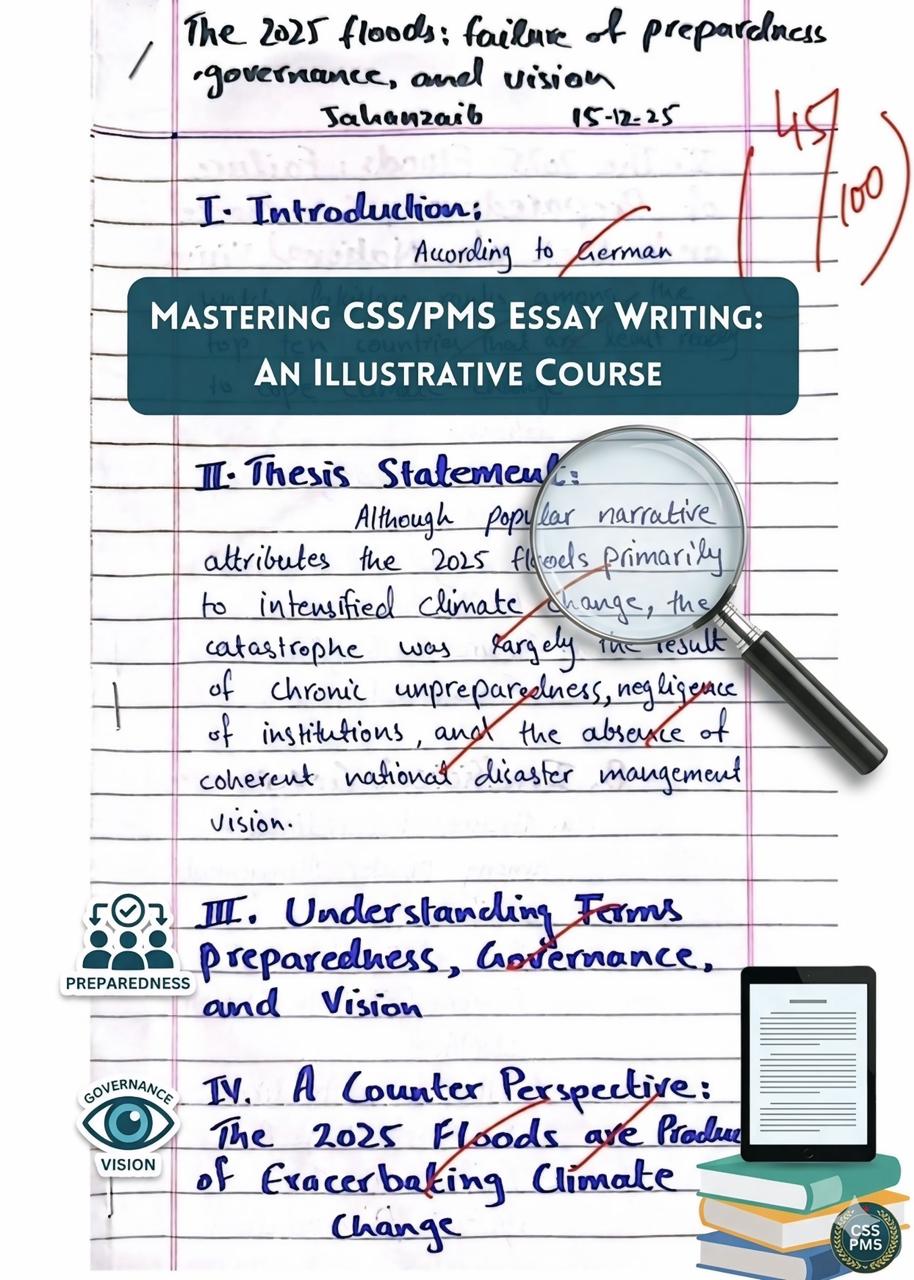
What is the CSS English Essay?
The CSS English Essay paper is one of the most decisive components of the Central Superior Services (CSS) examination conducted by the Federal Public Service Commission. It tests not just your English proficiency, but your ability to think critically, argue logically, and present ideas in a coherent and structured manner.
Candidates are required to write a comprehensive essay (typically 2500–3000 words) on a given topic within 3 hours. The essay must demonstrate clarity, depth, originality, and command over language.
Why This Paper is Crucial?
The essay paper is often considered a make-or-break subject in CSS. Every year, a significant number of candidates fail this paper despite strong preparation in other subjects.
Why?
Lack of structured thinking
Weak argument development
Poor expression and grammar
Irrelevant or unfocused content
Success in this paper demands skill, not just knowledge.
How to Write an Essay?
About This Guide
This document outlines the comprehensive essay evaluation framework used on this platform. It is designed to help CSS aspirants master the art of structured, coherent, and high-scoring essay writing. Each section corresponds to a specific dimension of essay quality assessed by examiners.
SECTION I: Introduction Structure & Content
1.1 The Six Introduction Methods
Every essay must open with one of the following six approved methods. Choosing the right method for the topic signals command of academic writing to the examiner.
# | Method | Key Characteristics |
1 | General to Specific | Broad context narrowing to your specific argument |
2 | Quotation | Direct & relevant quote that ties to your thesis |
3 | Question Format | Provocative rhetorical question to hook the reader |
4 | Contrast Method | Present two opposing realities to create tension |
5 | Relevance Model | Fact → Statistics → General Statements → Rhetorical Q → Thesis |
6 | Anecdote Method | Real-based narrative → Context → Rhetorical Q → Thesis |
Step-by-Step: The Relevance Model
- Open with a direct fact or hard-hitting statement related to the topic.
- Build immediate relevance using contemporary, credible statistics.
- Offer a few broad general statements to contextualise the issue.
- Pose a rhetorical question to draw the reader toward your argument.
- Close with the thesis statement as the final sentence.
Step-by-Step: The Anecdote Method
- Open with a compelling narrative example (e.g., the Christchurch incident for Islamophobia).
- Relate the anecdote to the broader essay topic with context.
- Pose a rhetorical question to create intellectual tension.
- Conclude the introduction with the thesis statement.
1.2 The Thesis Statement
The thesis is the single most important sentence in your essay. Examiners evaluate your entire essay against it. Follow these non-negotiable rules:
- Must appear as the final sentence of the introduction.
- Must take a clear, unambiguous position — no middle stance.
- Must be controversial and debatable, not a statement of fact.
- Must begin with an oppositional word such as “Although,” “Despite,” or “While.”
EXAMPLE | Although champions of democracy trumpet the virtues of open governance, the lack of diplomatic integrity in international relations clearly depicts that moral standards are completely absent from statecraft. |
SECTION II: Essay Body Structure
2.1 Term Explanation Paragraph (Conditional)
Include a dedicated term explanation paragraph only when the essay topic contains a complex, philosophical, scientific, or IR-specific term — such as ‘climate change,’ ‘neo-liberalism,’ ‘deterrence,’ or ‘sovereignty.’
- This paragraph immediately follows the introduction.
- Do not include it for straightforward, everyday topics.
- Its sole purpose is definitional — do not argue within it.
2.2 The Counter Perspective / Antithesis Paragraph (Mandatory)
This paragraph is obligatory in every essay, regardless of topic. It demonstrates intellectual maturity and awareness of the debate.
- Present the strongest argument against your thesis fairly and accurately.
- Acknowledge its merit where appropriate — do not strawman.
- Conclude the paragraph by pivoting back to and reinforcing your thesis.
KEY RULE | The antithesis paragraph must never be allowed to ‘win.’ It exists to set up a stronger restatement of your thesis. |
2.3 Main Body Paragraphs
Each main body paragraph must develop one of the points introduced in your thesis statement. The number of paragraphs follows directly from the number of claims made in your thesis.
- One point per paragraph — do not cluster multiple arguments.
- Begin with a clear topic sentence that signals the paragraph’s focus.
- Support with evidence, examples, statistics, or expert opinion.
- End with a signpost or transition sentence that links to the next paragraph or echoes the thesis.
SECTION III: Coherence and Unity
3.1 Echoing the Thesis
Every paragraph from the second onward must be explicitly tied to your thesis. This technique — known as thesis echoing — is the primary marker of a well-structured CSS essay.
- Reference the thesis claim your paragraph is addressing at its start.
- Use synonyms or paraphrase — do not repeat the thesis verbatim.
- The reader should never be in doubt about how a paragraph serves your argument.
3.2 Paragraph Unity
A paragraph must be built around a single, unified idea. This is one of the most frequently violated rules, and one of the most heavily penalised.
EXAMINER NOTE | Paragraphs that mix two or more arguments are a common and costly error. When in doubt, split the paragraph into two. |
3.3 Signposting and Transitions
Transitions guide the examiner through your argument. They are not decorative — they are structural. Use transitional sentences:
- At the end of each paragraph to link forward.
- At the opening of a paragraph to link backward.
- Within paragraphs to connect evidence to the argument.
SECTION IV: Major Errors to Avoid
The following errors are drawn directly from CSS Examiner Reports and result in significant mark deductions. Treat this table as your pre-submission checklist.
Error Type | Description / Impact |
Clarity | Ambiguous or wishy-washy stance — no middle ground allowed |
Tenses | Mixing past, present, future inconsistently within arguments |
Active/Passive Voice | Incorrect or unintended passive constructions |
Direct/Indirect Speech | Errors converting between reported and direct speech |
Punctuation | Misplaced commas, colons, semicolons, or missing full stops |
Spelling | Treated as an ‘academic punishment’ by examiners — zero tolerance |
Thesis Links | Paragraphs that do not echo or connect back to the thesis |
Paragraph Unity | Mixing more than one idea/argument within a single paragraph |
SECTION V: Model Essay Structure (Climate Change:A Myth or Reality)
The table below illustrates the recommended structure for a full-length CSS essay, using Global Warming as the model topic. This outline applies, with appropriate adaptation, to any argumentative essay topic.
Section | Paragraph | Purpose / Notes |
I | Introductory Remark | Hook the reader — e.g., Greta Thunberg’s speech at the UN |
II | Thesis Statement | Clear, controversial, oppositional — placed at end of introduction |
III | Term Explanation (if needed) | Only for complex/philosophical/IR jargon terms |
IV | Antithesis / Counter Perspective | Present opposing view, then reinforce your own thesis |
V | Manifestations / Evidence | E.g., Sea-level rise, Melting Glaciers (Global Warming) |
VI | Root Causes / Factors | E.g., Industrialisation, Deforestation |
VII | Solutions / Recommendations | E.g., Reducing Carbon Footprint |
VIII | Conclusion | Tie back to thesis; no new points introduced |
SECTION VI: Quick Reference Checklist
Before submitting any essay for evaluation, verify each of the following:
- Introduction uses one of the six approved methods.
- Thesis is at the end of the introduction, starts with an oppositional word, and takes a clear stance.
- Antithesis paragraph is present and concludes by reinforcing the thesis.
- Every paragraph addresses exactly one point.
- Each paragraph echoes or links back to the thesis statement.
- Transitions are used between and within paragraphs.
- Tenses, voice (active/passive), and reported speech are consistent and correct.
- Spelling and punctuation have been proofread — zero tolerance.
- Conclusion ties back to the thesis without introducing new arguments.
PKR 1000
This Package Includes
- Evaluated 20 full length essays and 20 content for 25 essays
- Access on desktop, tablet and mobile
- Full lifetime access
Evaluated Essays
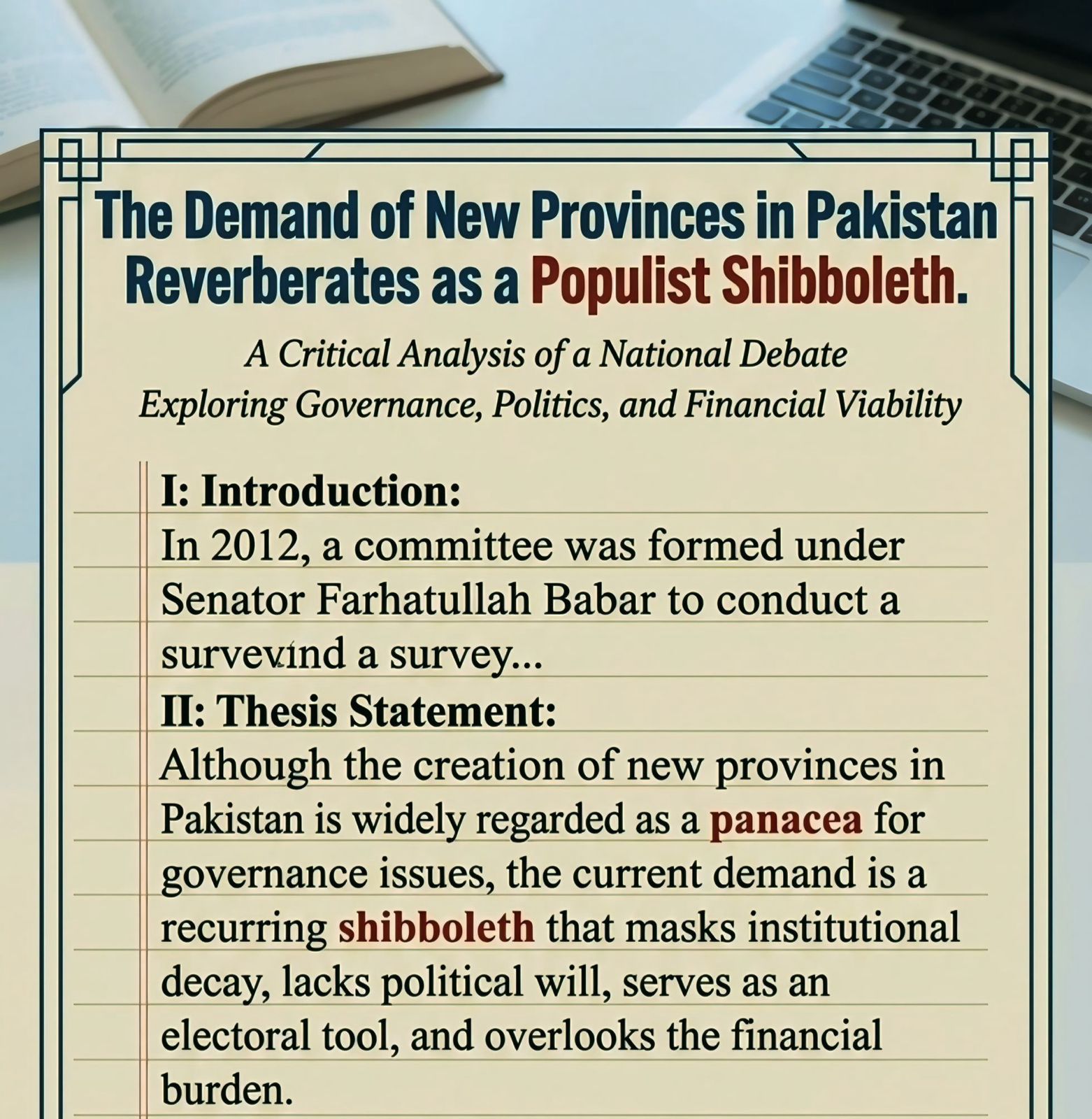
ESSAY: THE DEMAND OF NEW PROVINCES IN PAKISTAN REVERBERATES AS A POPULIST SHIBBOLETH
I. IntroductionIn 2012, a committee was formed under Senator Farahtullah...
Read More